From Constituent Complaint to Capitol Bill: One Lawmaker’s Two-Year Plan to Kill Property Tax in Indiana
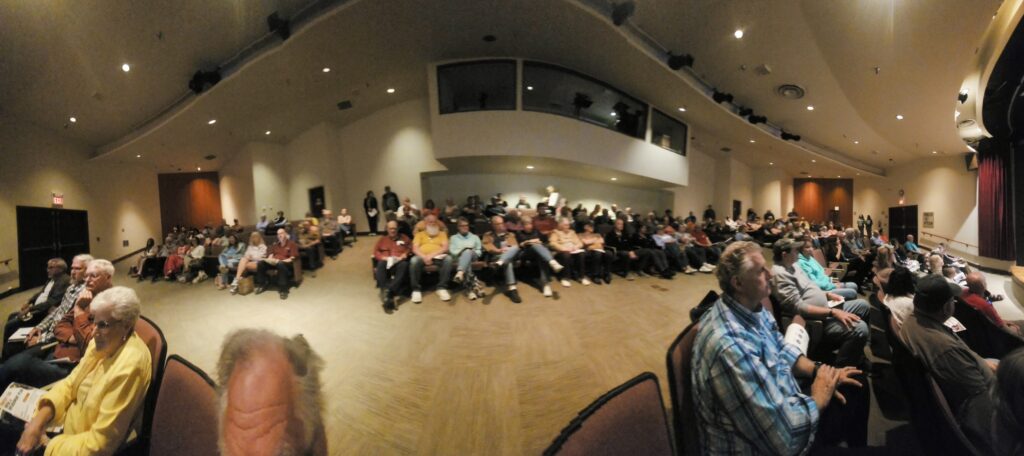
FRANKFORT — An Indiana state lawmaker unveiled a plan Thursday evening at Skanta Theatre to fully abolish the state’s property tax system and replace it with a 7 percent sales tax on most services, drawing a crowd of about 150 residents to the Frankfort Public Library for a town hall that stretched deep into Q&A.
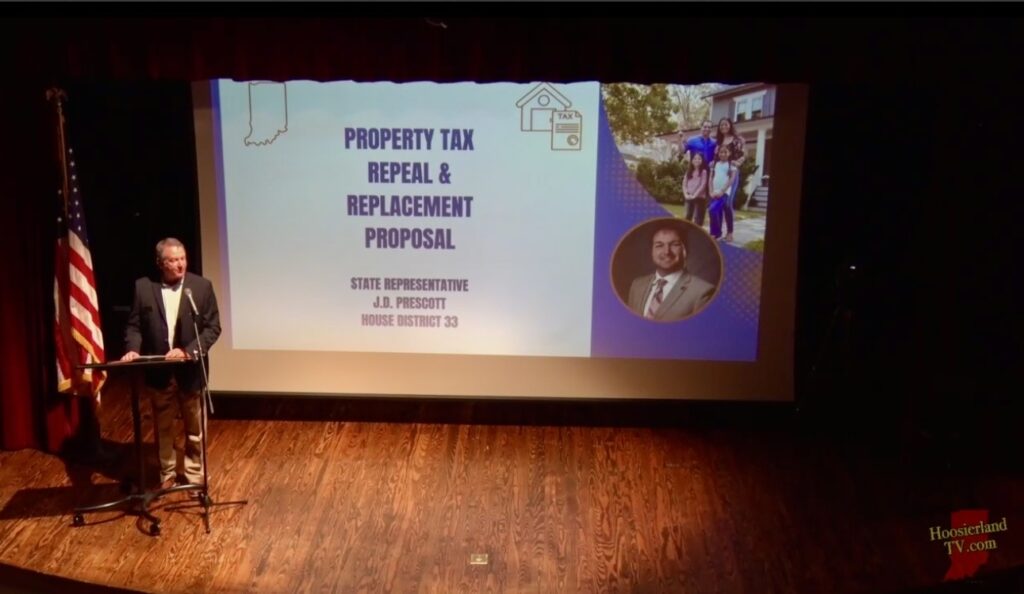
State Rep. JD Prescott, R-Union City, who represents House District 33, spent roughly two years developing the proposal before beginning a statewide listening tour. Clinton County was his first stop to propose his bill to Hoosiers across the state.
The presentation was broadcast LIVE on HoosierlandTV.com and is archived there for viewing on demand.
Prescott plans to reintroduce the legislation when the General Assembly reconvenes in November. The Frankfort event was hosted by State Rep. Mark Genda and was livestreamed by Hoosierlandtv.com. Genda, along with Hoosierland TV partners, hosted the broadcast on HoosierlandTV.com. The entire program including audience questions may be viewed below.
The Core Proposal
Under Prescott’s plan, property tax assessments would end after 2027. The last year property taxes would be payable would be 2028. Beginning July 1, 2028 — creating a six-month overlap with the final year of property tax collections — a 7 percent sales tax on services would take effect. Goods, which are already taxed, would not be subject to the new levy. Healthcare, education, childcare, nonprofits, and churches would be exempt.
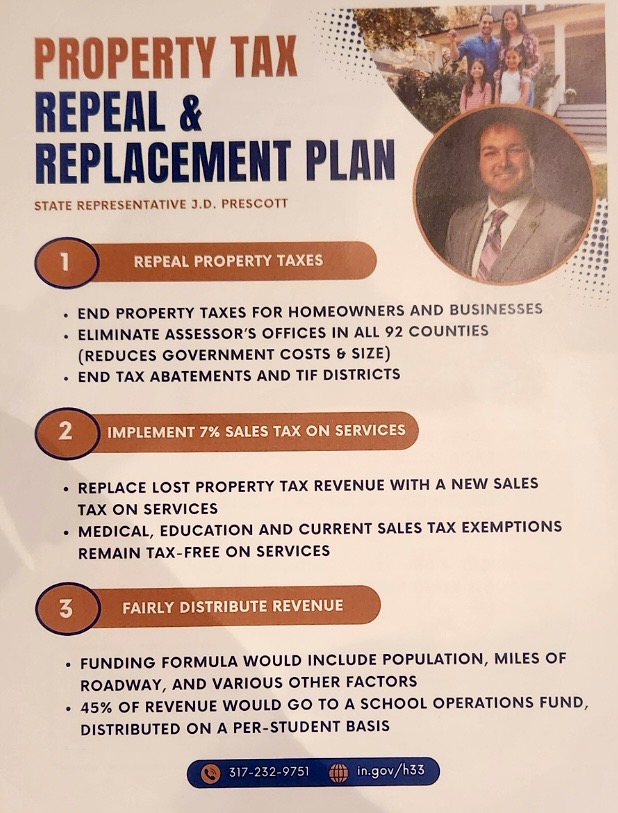
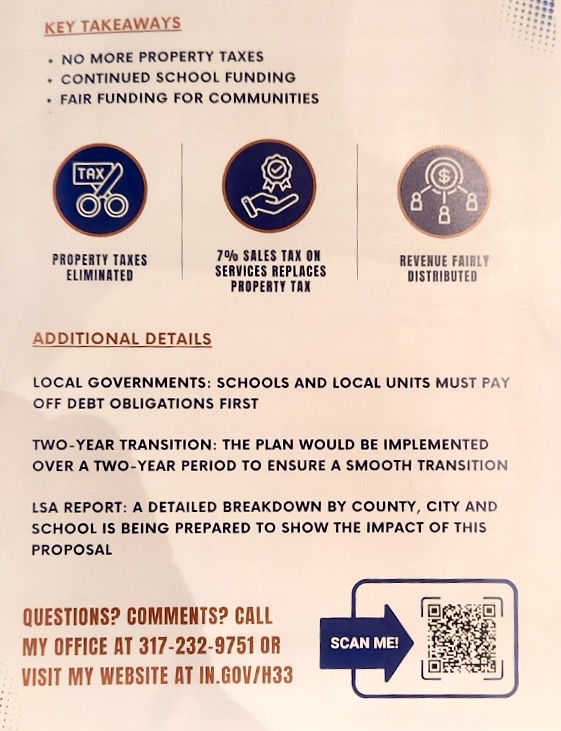
The Indiana Legislative Services Agency, the nonpartisan fiscal arm of the General Assembly, projects the services tax would generate between $13 billion and $15 billion annually — exceeding the state’s estimated $10.6 billion net property tax levies for all local units of government in 2027. The surplus would cover circuit-breaker losses and build a reserve.
Revenue distribution would work as follows: 45 percent to school operating funds, 20 percent to counties, 20 percent to municipalities, and the remainder to townships, libraries, and fire districts based on a five-year look-back of net levies plus circuit-breaker losses adjusted for inflation.
Ten percent of all revenue would flow into a local revenue sharing reserve account. Once that reserve reaches one year’s worth of funding, the rate would drop a quarter percent per year.
“Seven percent is the cap,” Prescott told the crowd. “The rate actually decreases over time with this plan.”
Why Property Taxes, and Why Now
Prescott said the proposal grew from conversations with constituents frustrated by rising tax bills on property they had owned for decades.
“A couple of constituents reached out to me asking, ‘Can’t we just get rid of property taxes?’” he said. “When I first started looking into repealing the property tax system, I’ll be honest, I thought I don’t even know if that’s even possible.”
Prescott’s philosophical objection to property tax runs deeper than the mechanics. Prescott argues that property taxes penalize homeowners for appreciation they have not converted into cash. “It’s a tax on unrealized gains,” he said. “You buy your home, you may have it for 30-plus years, and you’re not taxed at the price you paid. If we did that with investment accounts or brokerage accounts, people would come unglued.”
Prescott also challenged the concept of ownership itself under the current system.
“You never truly own your home,” Prescott said. “Once your mortgage is paid off, you’re continually making payments to the government to essentially lease that property.”
Fiscal Impact for Clinton County
Prescott presented localized projections for Clinton County. The county’s estimated 2028 net budget is $13,837,766. Under his distribution formula, Clinton County would receive between $15 million and $17.6 million — a gain of roughly $2 million to $4.5 million over current funding levels.
The plan would also eliminate assessor offices in all 92 Indiana counties and reduce workloads in auditor and treasurer offices, producing an estimated statewide administrative savings of $150 million to $200 million per year. No new debt backed by property taxes would be permitted upon passage, no new tax increment financing (TIF) districts could be created, and existing TIF districts would dissolve once their underlying debt is retired.
Questions From the Audience
The Q&A session surfaced several pointed concerns.
One audience member noted that Frankfort has a renter population approaching 40 percent, with many residents living below the poverty line, and questioned whether taxing services would place a disproportionate burden on lower-income residents. Prescott responded by returning to the county-level numbers, arguing that Clinton County as a whole would come out ahead financially under his formula.
A school board member asked whether charter school and voucher students would be included in the funding formula. Prescott said the structure mirrors the current education fund — dollars follow the student — and public schools receive the vast majority of dollars now and in his plan.
A business owner raised questions about what would replace property tax abatements and TIF districts as tools to attract economic development. Prescott argued that eliminating property taxes altogether is itself a significant incentive for businesses and that counties would manage economic development initiatives through their general funds.
Concern also arose about whether the state could eventually “claw back” the new system and reinstate property taxes — a parallel drawn to the lottery’s original promise of funding education and community projects such as construction of the Nature Center at Camp Cullom. Prescott said the two-year wind-down period makes reinstatement considerably more difficult in practice, and he repeated his support for an accompanying constitutional amendment. “I think it is important to have a constitutional amendment run at the same time as this — to put in as a constitutional protection that property taxes could not come back,” he said. Notably, Prescott, however, said he would sponsor and vote for the bill even without constitutional guarantees because he believes “it is the right thing to do.”
Genda’s Reaction
State Rep. District 41 Mark Genda, who hosted the event and introduced Prescott, made clear at the outset that he had come to the meeting as a listener, not an advocate. He told the crowd he had “not looked at one piece” of what Prescott was presenting and was there “just as you are — to learn, absorb, and be your voice in Indiana.”
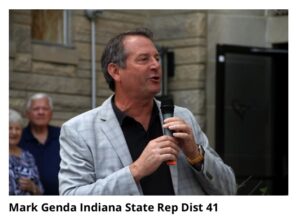
Genda opened the Q&A by asking the audience to raise their hands if their property taxes had gone up. Virtually every hand in the room went up. He then facilitated the Q&A, thanked Prescott for sharing the plan with Clinton County, and invited further questions from the audience. Genda was pleased with the turn out and indicated he was still in a listening mode. Genda is listening to the evolving proposal as numbers are clarified, and listening to his constituents and what their thoughts are on the proposal.
Next Steps
Prescott said the listening tour is designed to surface problems before the bill moves into committee.
“I would rather find the problems now and try to figure out a solution before it gets to that committee point,” he said.
Residents who want to weigh in before November can scan a QR code Prescott provided at the meeting to access a feedback survey. Prescott also encouraged attendees to contact their local associations and elected officials to register support or opposition ahead of the legislative session.