
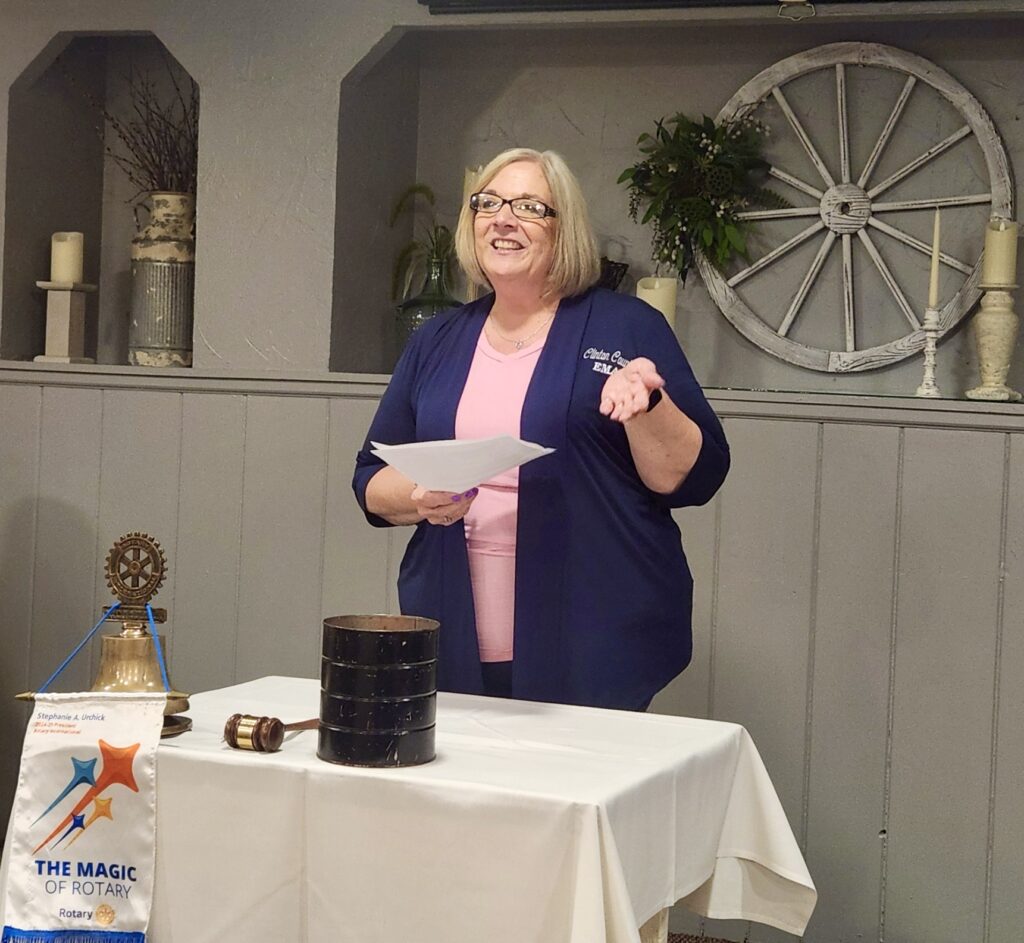
Frankfort Rotary Club members heard from one of Clinton County’s key public safety leaders, Emergency Operations Director Renee Crick, who outlined the county’s advancements in 911 dispatch, technology upgrades, and disaster preparedness during her visit. Crick, a veteran of 36 years in local public safety, now oversees both Central Dispatch and the Emergency Management Agency (EMA) under a combined administrative structure.
“I started as a part-time dispatcher in 1990,” Crick told the group. “When we consolidated dispatch services for police, fire, and EMS into one center, it truly became one of the best decisions the city and county ever made.”
Modern 911 Operations in Clinton County: Looking for 2 more dispatchers
Crick described the evolution of the county’s emergency communications system, emphasizing faster response times, better coordination, and upgraded technology. Clinton County currently employs 17 dispatchers and an assistant director, with plans to hire two more, allowing for five dispatchers per shift.
The center answers an average of 37,600 calls for service annually, including more than 12,900 emergency calls. Crick said improved staffing has helped relieve overtime pressure on employees and strengthen overall performance.
“This was the first year we didn’t have to request extra funds for overtime,” she noted. “Adding a fifth dispatch position really turned things around and helped prevent burnout.”
New technology also plays a crucial role. Crick highlighted RapidSOS, a real-time location tracking system that shows emergency callers’ positions with pinpoint accuracy. “When we tested it, we could see exactly which side of Old Stoney the caller was on,” she explained. “It’s made a huge difference, especially for drivers on I-65 who don’t always know where they are.”
The county’s dispatchers also manage text-to-911 capabilities and access to a language line offering interpretation in hundreds of languages. “It’s essential for the hearing impaired or anyone who can’t safely make a voice call,” Crick added.
When asked what message she wished everyone understood most, Crick was direct: “Know your location. The first thing we ask is, ‘Where is your emergency?’ If we lose connection, at least we can still send help.”
Supporting Staff and Mental Health
Crick’s remarks also touched on the emotional demands of dispatch work, citing stressful incidents such as last year’s officer-involved shooting and other life-threatening calls.
“Our staff hears things they’ll never forget,” Crick said. “They come back every day and do it again—and that takes very special people.” One rape trial case used Clinton County 911 audio of the rape to help convict the defendant, who is currently serving time in prison.
Employees have access to confidential mental health support through an employee assistance program. “They don’t have to come to me or my assistant,” she explained. “They can reach out on their own, and we take care of the costs anonymously. It’s so important that they have that.”
Transition into Emergency Management
Now also serving as EMA Director, Crick said her combined role helps bridge communication between 911 operations and emergency coordination countywide.
“EMA is responsible for planning and coordinating for the entire community,” she said. “That includes working with schools, the health department, and other agencies during severe weather or disasters.”
During winter weather, Crick personally drives county roads to assess conditions before issuing travel advisories. She also oversees the county’s **11 tornado sirens** and coordinates Nixle/Everbridge alerts to keep residents informed of emergencies and road closures.
EMA recently hosted a public training session on **disaster cost recovery and federal assistance**, helping local leaders understand how to document damages and reclaim expenses following major incidents.
“I hope we never have a disaster,” Crick said, “but I want us to be prepared if we do.”
Planning for the Future
Crick also announced that Clinton County’s multi-hazard mitigation plan, required every four years for FEMA eligibility, has received preliminary approval from the Indiana Department of Homeland Security and awaits final review by FEMA. Every municipality in the county participated in developing the plan, a first for Clinton County.
“That level of cooperation really excited me,” Crick said. “It shows that everyone came to the table to plan for the future.”
Despite the growing scope of her work, Crick said her passion for public safety and her home county remains strong. “I’ll always be a dispatcher at heart,” she concluded. “I love this community, and I love what I do.”