
FRANKFORT — Supporters and skeptics of a proposed multibillion-dollar data center proposed for west of Frankfort spent Monday evening moving booth to booth at the 51 West Event Center, questioning engineers, consultants and city officials about water use, noise, lighting, power and taxes.
Dataone hosted the open house from 5 to 8 p.m. at 51 West Event Center, setting up stations staffed by subject-matter experts on cooling and water treatment, sound, lighting, roads and storm water, electrical supply and the project’s fiscal impact. Attendees were free to question each one directly.
The event was peaceful and law enforcement personnel were present at the event.

Water dominated the questions
The single most common concern was water — not the volume, but what happens to it.
Company representatives said the facility would use a closed-loop cooling system, with treated water circulating between indoor equipment and outdoor dry coolers. Routine losses would come only from small pipe and pump leakage, estimated at an industry-standard 2%, and from the few gallons captured when a piece of equipment such as a GPU is swapped out. On days above roughly 86 degrees, an adiabatic misting system sprays a fog beneath the outdoor coolers to improve efficiency. Water vapor utilized in the cooling process is based on a physical process called “evaporative cooling.” Water used in this process does not have to come into direct contact with any component or equiptment, but changes the temperature of the air by absorbing heat and creating a phase change from liquid to gas, effectively cooling the air around the mist. Dataone representatives put average use at about 20,000 to 22,000 gallons a day, roughly 8 million gallons annually, and said the mist contacts air rather than equipment surfaces, making claims of toxic runoff “misinformation.”
Several attendees were not satisfied. A water professional who works in rural water systems and attended with a protest sign said he accepts that the projected volume is modest — noting Frito-Lay uses several million gallons a day and agreed that the data center would not rank among Frankfort’s top 20 users — but said no one at the open house could tell him what becomes of contaminants and spent filters removed during treatment. He said he was referred to the company’s website. Data One engineers were asked about this and said the filter and small excess water disposal process must be “handled by a permit process” that must be in compliance with regulations.

One attendee who identified himself as a degreed engineer pressed the point repeatedly, arguing that even a closed loop eventually requires discharge as water picks up impurities from piping. A Dataone representative acknowledged he could not say what happens to used filters, said there is no intent to drain and refill the loop, and said any discharge would go through a state permitting process.
Power, noise and dark skies
Electrical engineer Kevin Thomas said the campus would draw 350 megawatts of utility power through IMPA, supplemented by 175 megawatts from Bloom Energy natural gas fuel cells. He said Dataone is paying for all associated infrastructure, including cabling and substations, and that a 65-megawatt temporary substation would be turned over to Frankfort for future development at no cost to ratepayers.
Asked about Clinton County’s lighting ordinance, Thomas said he was not personally familiar with it but that licensed design consultants would ensure compliance and that fixtures would be dark-sky compliant with no uplight — a point of particular interest given the county’s 28-inch telescope roughly three to four miles from the site.
Clinton County’s Lighting Ordinance: CLICK HERE
Acoustic consultant Graham, of a firm contracted by Dataone, said sound predictions are still in progress and will be modeled on worst-case operating conditions against the city’s noise ordinance. He said modeling below 31.5 hertz is limited by what equipment manufacturers provide.
The fiscal case
Gary Smith, CPA and partner at Reedy Financial Group PC — the city’s independent financial advisor — presented projections showing Frankfort facing roughly a $4.3 million to $4.5 million revenue shortfall in 2030 from state property tax and local income tax reform under SEA 1, independent of any data center decision. Balancing that gap through cuts, he said, could mean about 40 full-time positions, roughly 20% of the city of Frankfort’s workforce.
Smith described the project as a $7.5 billion investment — about five times the city’s entire existing taxable value of $1.5 billion. Of that, $825 million is real property, carrying a proposed 50% abatement for 10 years; Smith projected $100 million in real property taxes over 25 years, with $20 million abated and $80 million retained locally. Enterprise IT equipment, which he noted is fully exempt under current Indiana law, would instead generate economic development impact payments of $4.5 million a year from 2030 through 2054, rising with the consumer price index.

Total value to Frankfort: about $331 million through 2054, or an average of roughly 41% of the city’s annual budget. Smith said the figures are his own and that Dataone had not seen them.
Rick Gunyon, an interested citizen who also serves on the Frankfort Utility Board, said engineers from IMPA and other utilities modeled the electrical demand and concluded it would not affect current or future customer rates, with all expansion costs developer-paid. “To me it’s a win-win,” he said, adding that the council’s choice is between decades of added revenue or likely layoffs.
Opposition remains firm
Deborah Pearson, a candidate for county council from Center Township, said she is “adamantly opposed.” She argued the state’s tax cuts have pressured communities into viewing data centers as quick revenue, questioned whether closed-loop systems are truly closed, and said purged water is a pollutant wherever it is disposed. She also raised transparency concerns, saying she asked last week about nondisclosure agreements and was told by the mayor that the mayor had not signed one but could not speak for seven other people.
The following flyer was distributed by a protester located on Columbia Street near the Open House at 51 West.
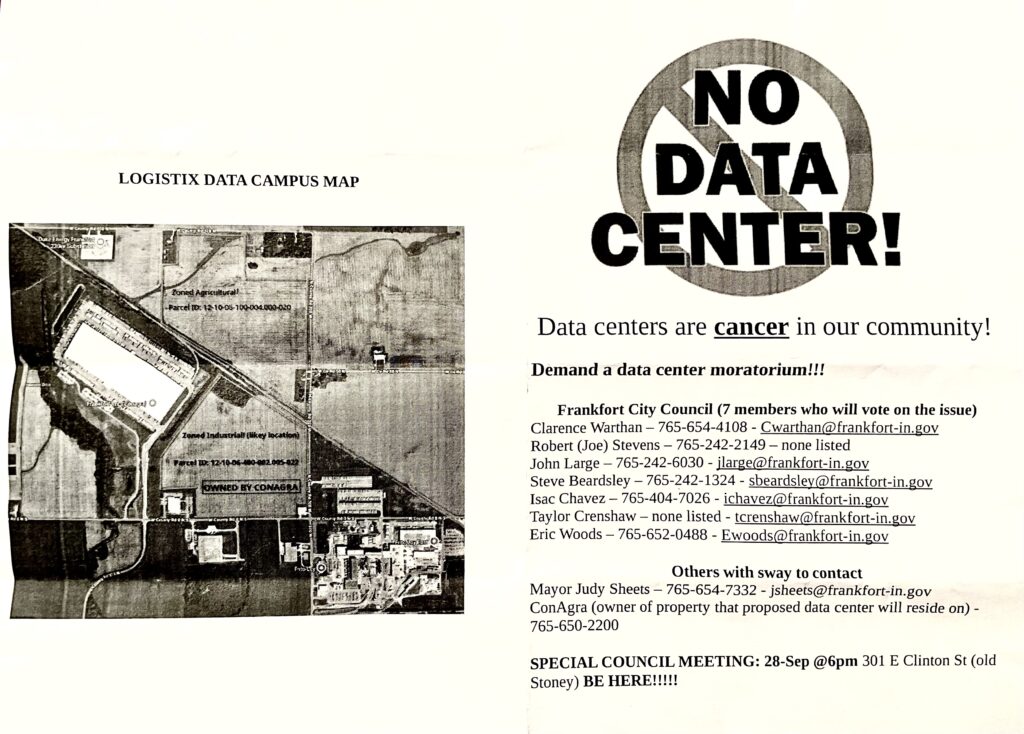
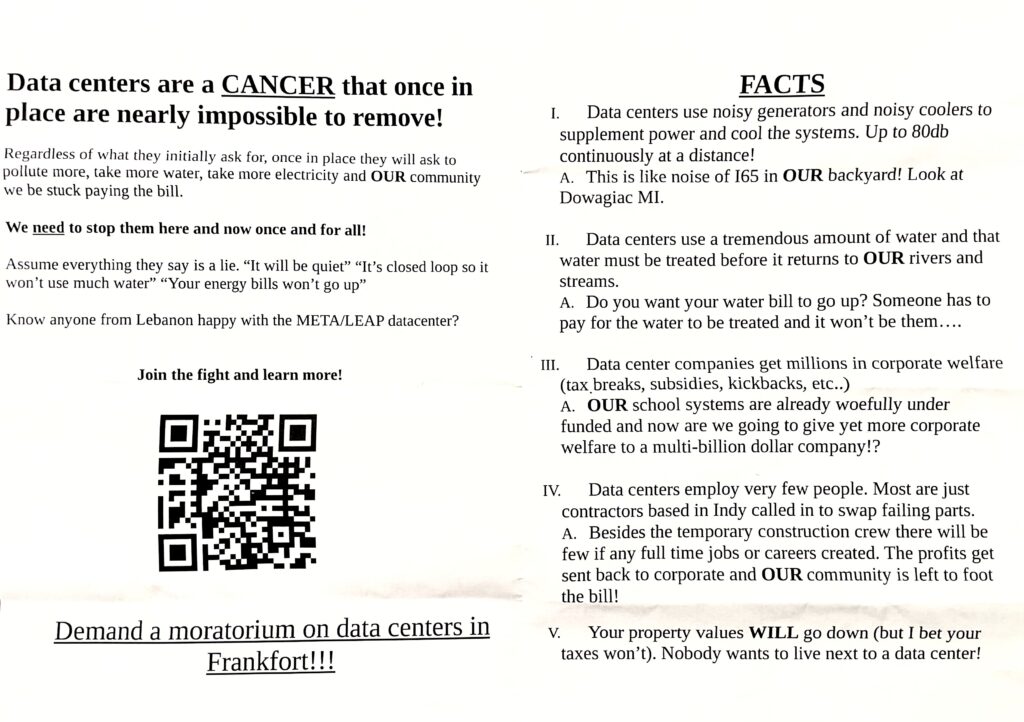
A second protester, who declined to give his name and wore a mask, called data centers “a cancer in the community,” predicting incremental expansion of generators, water draw and pollution once the facility is approved, along with higher utility costs for residents on fixed incomes. He pointed to road damage and water complaints in Boone County and said he would be satisfied with the kind of food and pet-food manufacturing already in the industrial park. He urged residents to attend a 5 p.m. gathering Sept. 28 at Old Stoney ahead of the Common Council.
Another longtime attendee, a former city employee, said the proposal passed through the Board of Zoning Appeals years ago without public objection but that recent negotiations have felt closed off. “I think this has been brought in in the dark again,” he said, noting a payment package became public only after he inquired about NDAs.
The mayor’s view
Mayor Judy Sheets, who votes only to break a tie, said she was encouraged by the turnout. “The experts are here. They can answer your questions one on one,” she said, urging residents to contact council members directly and warning that some circulating information is outdated as the technology changes.

Sheets acknowledged the proposal is imperfect. “This is not a perfect project,” she said. “There is no perfect project.” Asked what troubles her most, she pointed to the division in the community. “I hate what it’s doing to our community,” she said. “You can think different than me, you can have a different opinion. Let’s work together.”
Asked whether the revenue alone justifies approval, she said no. “This isn’t all about the revenues. This is about what’s best for our community.”