
In a perfect world, scientific research would not need Clinton County native Jamie Mohler.
In a perfect world, scientists would not fabricate, falsify or plagiarize data or information.
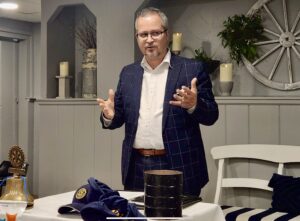
Unfortunately, this is not a perfect world. “I am not necessarily a person you want to get an e-mail or phone call from” said Mohler, Associate Vice President of Scientific Integrity and Research Compliance (AVPSIRC) and Research Integrity Officer (RIO). He is also a professor of Computer Graphics Technology at Purdue. In his personal life, Jamie is the music director for both services at the Frankfort First Church of the Nazarene and plays base guitar, and handles the computer/music interface of the services as well.
Mohler gave a talk to the Frankfort Rotary Club last Thursday and briefed the audience on some of the ‘behind the scenes’ safeguards needed to preserve good research at Purdue University.
Purdue University has a keen interest in keeping its research free of
- Fabrication (Fake Data)
- Falsification (Observation happened but Data were made ‘cleaner’, photos were made darker or lighter to suit the desired outcomes)
- Plagiarism (Using other’s ideas or words as the scientist’s own)
Why is it so important to Purdue University to make sure its research is free of these ‘termites’ that can infest and destroy research?
- If the research is medically related, the health, lives and safety of others rely on good data.
- Sound Policy is based on sound data. Bad Data equals bad policy.
- Research may be taxpayer funded and must be true and accountable to the public
- Future research may try to build on bad data. This is wasteful, expensive and potentially harmful to taxpayers and society as a whole.
- Purdue’s good reputation must be preserved. This is done in research in part, through good, valid data.
There are many cases across the nation where scientists fabricated, falsified or plagiarized data. Purdue University conducts a large volume of scientific research annually, receiving over $647,000,000 in research funding for the fiscal year 2023-24. This funding supports approximately 3,500 research projects across various fields, according to Office of Research at Purdue University. The primary fields of research at Purdue University are national defense, healthcare, agriculture, energy, and technology innovation.
Mohler’s responsibilities even encompass ethical and security details such as setting and enforcing policies involving human and animal subjects in research and guarding against potential security adversaries such as Russia, Iran, North Korea and China.
If a discrepancy occurs in research and the bad data comes to the attention of the Research Integrity office, the case will go through logical steps. Is the discrepancy concern valid? Is it intentional? What are the comments and inputs from Faculty peers and experts in the area? If necessary, the matter can be brought up in a formal review process and appropriate action or punishment will be taken to address the discrepancy.
Mohler said scientific malfeasance often starts slowly, perhaps even carelessly. Unchecked, the issue can grow into full blown Fabrication or Falsification, obviously undermining the integrity of research of the individual(s) involved. Oftentimes the discrepancy is discovered and reported by a concerned “outsider” such as a lower level assistant or student.
Some research integrity problems nationally are as simple as a one-time careless error. Other cases nationally have resulted in mass retractions impacting careers and years or even a lifetime of research.

Mohler cited the case involving the resignation of Stanford President Marc Tessier-Lavigne in 2023 following investigations into manipulated data in several of his research papers. The investigation cleared him of personally engaging in research misconduct but found that data manipulation occurred by others in his lab and were not corrected.
This topic is summed up beautifully by none other than Albert Einstein who said “Whoever is careless with the truth in small matters cannot be trusted in important affairs” and by Richard P. Feynman who said, “The only way to have real success in science…is to describe the evidence very carefully without regard to the way you feel it should be.”