
A pair of Clinton County farm boys who helped change humanity’s understanding of the universe are about to get their due in their hometown.
A new Indiana State Historical Marker honoring astronomers Vesto and Earl Slipher will be dedicated this summer during the Indiana Family Star Party on August 8th at Camp Cullom’s Prairie Grass Observatory. The dedication program at 11:30 AM will be led by Kevin Schindler, historian and public information officer for Lowell Observatory in Flagstaff, Arizona, where the Slipher brothers spent their celebrated careers. Dr. Catherine (Caty) Pilachowski, Distinguished Professor of Astronomy from Indiana University will participate in the dedication and will also speak at the Astronomy gathering at Camp Cullom later that day.
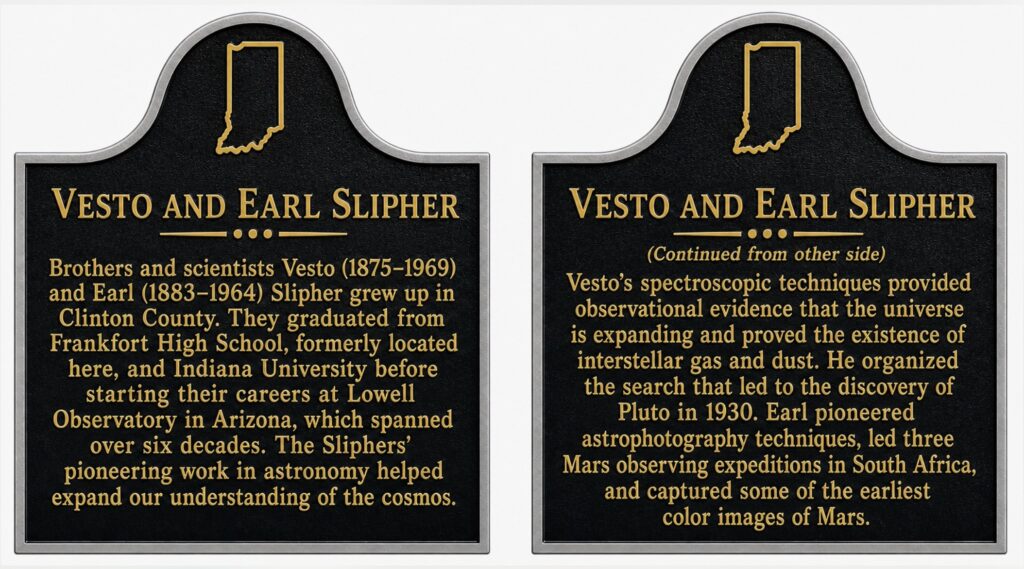
Vesto (1875–1969) and Earl (1883–1964) Slipher grew up in Clinton County and graduated from Frankfort High School before continuing their studies at Indiana University, then heading west to join Lowell Observatory near Flagstaff, Arizona. From those small-town beginnings, their work would reshape modern astronomy.
At Lowell, Vesto Slipher was among the first astronomers to systematically measure the spectra of spiral nebulae—what we now know are distant galaxies. His careful measurements of galactic redshifts in the 1910s and 1920s provided the first strong observational evidence that most galaxies are racing away from us, laying the groundwork for the modern theory of an expanding universe later associated with Edwin Hubble. Vesto also confirmed the existence of interstellar gas and dust and discovered reflection nebulae, proving that space between stars is far from empty.
Earl Slipher became one of the world’s leading experts on the planet Mars. Over more than five decades, he led major observing campaigns and photographic expeditions, including trips to observatories in South Africa to capture high-quality images of Mars at opposition. Earl’s pioneering planetary photography produced some of the earliest and best color images of Mars, helped document seasonal changes such as polar caps, clouds, and dust storms, and culminated in an influential volume often cited by later planetary scientists.
CLICK HERE for information about Crater on Mars Named after Sliphers.
CLICK HERE for information about Lunar Crater Named after Sliphers.
Together, the Slipher brothers’ work provided crucial evidence that the universe is expanding, revealed the nature of the material that fills interstellar space, and advanced our understanding of the planet that would become a prime target for space exploration. For astronomers around the world, their names are woven into the story of modern cosmology and planetary science.
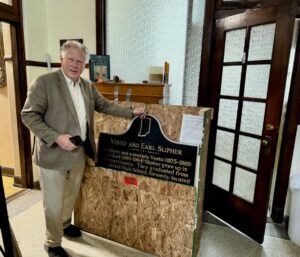
The new two-sided historical marker, now delivered to Frankfort, summarizes that story and ties it back to the community where it began. One side highlights the brothers’ Clinton County upbringing, their Frankfort High School and Indiana University educations, and their long careers at Lowell Observatory. The reverse side explains Vesto’s spectroscopic work that provided observational evidence for an expanding universe and the existence of interstellar gas and dust, as well as Earl’s groundbreaking Mars photography and international observing expeditions that produced some of the earliest color images of the Red Planet.
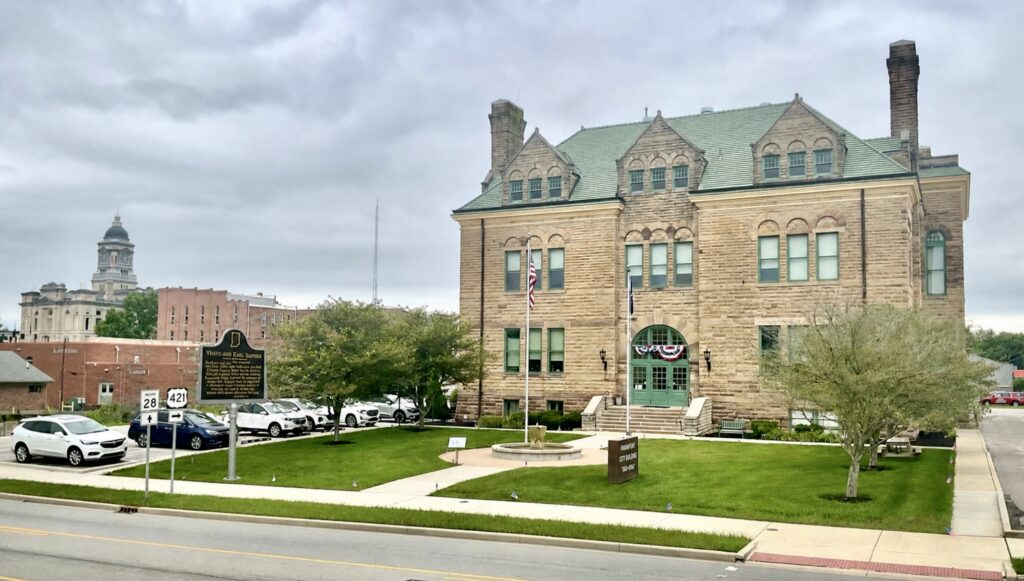
A site near the Frankfort City Building “Old Stoney” has been selected so residents and visitors can easily see the marker and learn how a story that stretches from Indiana cornfields to Arizona mountaintops and South African observatories began in Frankfort and Clinton County. The Slipher Brothers attended High School at Old Stoney before it became home for the City of Frankfort administration. The marker will stand as a daily reminder that world‑class science can grow from small Midwestern communities.
Bringing the Slipher marker to Frankfort has been a collaborative effort involving local, regional, and statewide partners. The project was carried out in cooperation with Frankfort Mayor Judy Sheets and the Frankfort Board of Works; Camp Cullom’s Prairie Grass Observatory and the Wabash Valley Astronomical Society; the Clinton County Historical Society and Nancy Hart; Clark Slipher and the Slipher family; Indiana Astronomical Society: Tom Borlik (IAS’ Gothe Link Observatory Historian); the State of Indiana; and Kevin Schindler and Lowell Observatory in Flagstaff, Arizona.
Schindler, who has written extensively about Lowell Observatory’s legacy, notes that without Vesto Slipher’s radial‑velocity measurements of galaxies and Earl Slipher’s meticulous Mars observations, key chapters of twentieth‑century astronomy would look very different. His appearance at the Indiana Family Star Party at Camp Cullom August 8th will connect today’s amateur astronomers and local residents directly to that history.
Details about the exact date and time of the dedication program at the Indiana Family Star Party will be announced soon.
Organizers say they hope the new marker will inspire students, stargazers, teachers and community members to see Frankfort and Clinton County not just as a place on the map, but as the starting point of a story that helped the world understand the cosmos in a new way.
Vesto and Earl Slipher were honored as posthumous inductees in the Frankfort Hot Dog Alumni Hall of Fame’s 2023 class. Vesto (Frankfort High Class of 1897) later became director of Lowell Observatory, and Earl (Class of 1902) became known for his photographic studies of Mars and the brighter planets, achievements cited in their Hall of Fame recognition.
The induction ceremony took place at Frankfort High School on July 29, 2023, during the sixth annual Hall of Fame event.