Frankfort Mayor Judy Sheets says the city’s newest fire engine is paid for in full, even as looming changes in state tax law and rising costs make long‑term budgeting more difficult for local governments.
Speaking Friday on WILO 96.9 FM, 1570 AM and Boone 102.7 FM’s “Party Line” program, Sheets outlined major public safety investments, walked through how city finances work, and invited residents to a slate of spring events and cleanup efforts.
New Engine 3 Dedicated April 16
Sheets said she is “so excited” about the arrival of the Frankfort Fire Department’s new Engine 3, a roughly $800,000 apparatus that will serve the city’s growing territory following recent annexation.
The engine will be blessed during a public ceremony Thursday, April 16, at 5 p.m. at Fire Station 3, across from the radio station on West Barner Street.
“They’re gonna have a blessing of the engine and that’s going to be April 16th at 5 o’clock,” Sheets said. “We’re going to have people there to say a few words and just to let everybody have the opportunity to see this new engine.”
Note: Hoosierland TV plans to broadcast the event LIVE World-wide and then archived for On-Demand viewing at HoosierlandTV.com.
Sheets emphasized that the truck is already fully funded.
“That engine is paid for in full,” she said, explaining that the city used a combination of American Rescue Plan (ARPA) dollars, Redevelopment Commission funds and City General dollars. “I think it shows that we did our due diligence as well as when we planned for this to happen. We’re not always able to do that. That engine was over eight hundred thousand dollars.”
The new engine joins an ongoing project to build a new fire station as the city adjusts to annexation that extended fire, police and street department responsibilities out to the interstate.
“Our territory now, jurisdiction, reaches clear out to the interstate,” Sheets said. “So our fire department, police department, street department, all those services had to expand with that annexation.”
State Tax Changes and City Finances
Sheets used part of the broadcast to clarify how city funds work and to warn that proposed changes in state statute could stress local budgets in coming years.
“One of the things that I want people to know is how different funds are used for different purposes,” she said. “Not everything is property tax‑based or income tax‑based. There are certain ways that we bring those revenues in and what they can be used for.”

She noted that tax increment financing (TIF) revenue from largely industrial areas helps pay bonds for Prairie Creek Park and the aquatic center, rather than traditional property taxes.
“That’s how we pay for the bond for Prairie Creek Park along with the aquatic center,” Sheets said. “Nobody’s tax dollars as such are used for those bond payments. That’s all from the TIF area, which is mainly industrial.”
Sheets also responded to a caller’s question about the city’s cash reserve, saying City Hall still aims to keep about 180 days of operating funds on hand but cannot always hit that mark.
“It’s always our goal to have a hundred and eighty days. It’s not always possible, you know, with the budgeting process and if there’s cuts in revenue or some expenses that come up that we don’t expect,” she said. “Sometimes that changes from year to year… but we still keep that goal in mind.”
Looking ahead, Sheets said she is closely watching changes tied to Senate Bill 1 and potential adjustments to local income tax streams.
“That’s gonna be very, very stressful for our community if that continues in the direction that it’s going from a financial standpoint,” she said. “We have to look at the future. We have to look at what’s gonna come on down the road.”
She said possible restructuring of the public safety local income tax could force the city to rethink how it funds fire, EMS and police services.
“There’s going to be a lot of adjustments if things keep going in the direction that they are right now,” Sheets said. “We’re [going to] have to put a lot of thought and effort and do our due diligence to make sure as we budget going forward.”
Encouraging Civic Engagement
Sheets repeated that many decisions attributed to the mayor are actually made by the Common Council or Board of Works.
“A lot of things take council votes,” she said. “I don’t even vote unless there’s a tie.” She added that the council is the city’s legislative body, responsible for setting and approving the budget and passing ordinances and resolutions.
The mayor urged residents to attend meetings, watch online and bring questions directly to city leaders rather than rely on social media.
“You can’t just assume or think this is what happens,” she said. “If you come here and you hear, you can hear it from me [and] from the department heads … it’s not a social media thing. This is what’s really happening.”
Muffins with the Mayor, Sparkling Success and Spring Cleanup
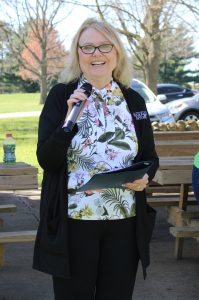
Sheets said she is eager to move her popular “Muffins with the Mayor” sessions back outdoors as the weather improves. April’s gathering will still be held at 9 a.m. Tuesday in Harry’s Coffee Shop in the lower level of the Frankfort Community Public Library, but beginning in May the event is expected to return to the park.
“My favorite thing is that people come there with questions and they’re eager to learn,” she said. “They want answers, and when you talk to them about things, they listen… I love to see a lot of people there.”
The mayor also promoted several upcoming events:
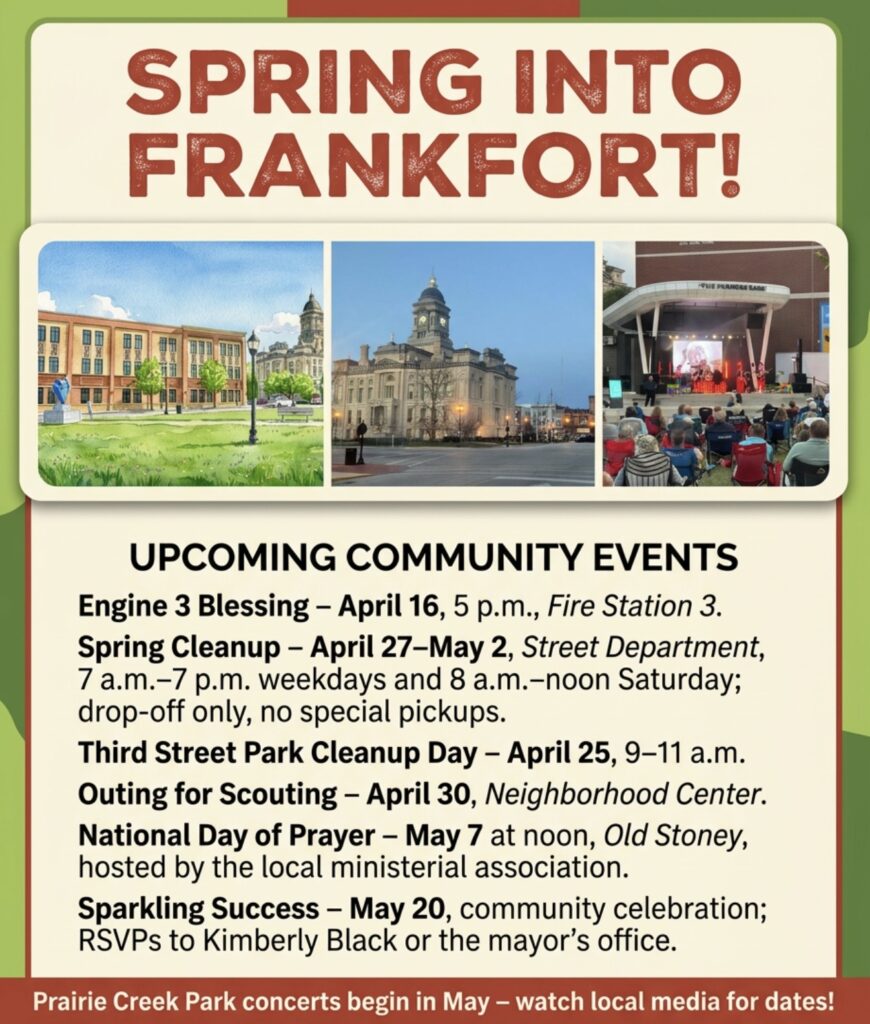
“As you can see, we have many events this spring” Mayor Sheets said.
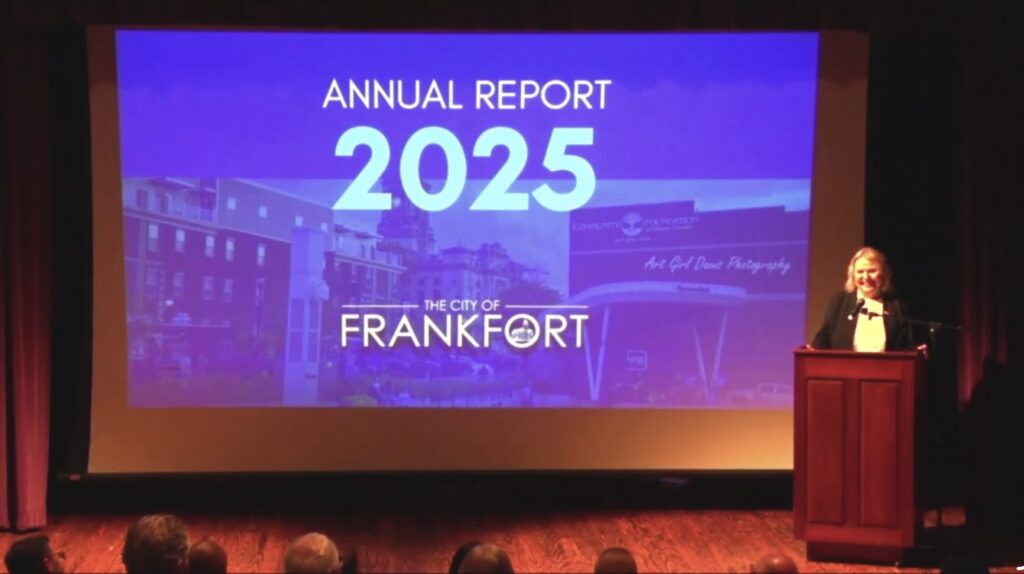
Click below for the Mayor’s “State of the City” address delivered at the Skanta Theatre-Frankfort Community Public Library on Tuesday, March 31st:
Address begins at the -46:15 Mark.