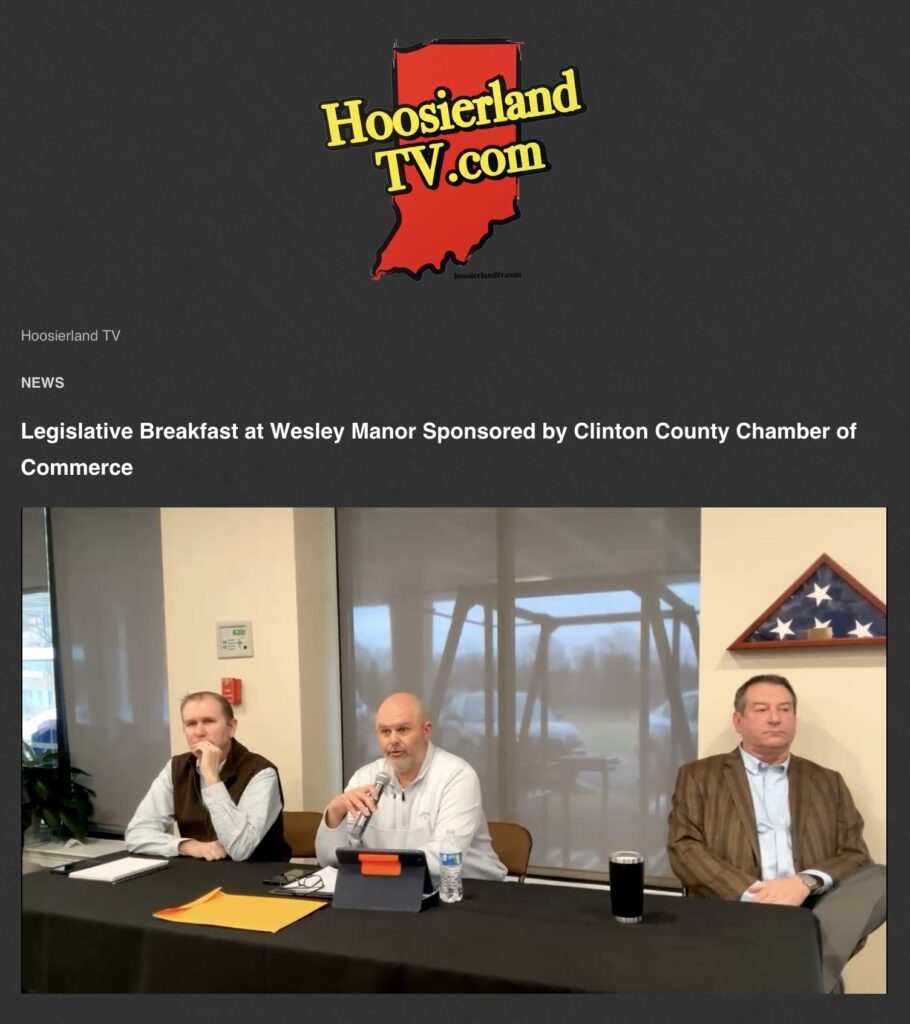
Republican lawmakers representing all or parts of Clinton, Boone, Hendricks, Montgomery, Howard, Tipton, Cass and Tippecanoe Counties faced sharp questions from local residents Saturday over a controversial immigration enforcement bill even as they highlighted action on property tax relief for disabled veterans, Medicaid spending and utility rates.
Immigration bill dominates breakfast
Much of the hour-long Legislative Breakfast at Wesley Manor centered on Senate Bill 76, a sweeping immigration enforcement proposal that would require local governments, schools and other public bodies to cooperate with federal Immigration and Customs Enforcement (ICE) detainers. Residents pressed legislators on racial profiling, school safety and the bill’s impact on local jails and budgets.
Rep. Mark Genda of Frankfort said he broke with most of his party on the measure. “It was a lonely vote for me. I was one of two that voted no on that bill on the Republican side,” Genda told the crowd, drawing applause. “Immigration is a federal issue and we start bringing in local and state police, we have now removed them from the streets.”
Genda said he also objects to what he called “the enormous amount of power that we just turned over to our AG. Our Attorney General now has more power in this bill than I believe he should have in his office.”

Senate Bill 76 would require local governments and law enforcement to honor ICE detainer requests and prohibits policies that impede immigration enforcement by federal or state officers. Supporters argue the bill simply aligns Indiana with federal law, while opponents warn it will pull schools and local police into federal immigration work and chill families from sending children to class.
Sen. Brian Buchanan said he intends to review the latest House changes before a final Senate vote. “I do feel this is a hugely important issue when it comes to immigration on a national level,” Buchanan said. “I think the focus needs to be where I think it is right now — getting those with a criminal background, criminal history out. … We’ll evaluate it. We’ll see where it goes.”
Rep. Heath VanNatter, who supported SB 76, told the audience, “I’m voting for 76. It’s complying with federal law.” He noted the bill is now back in the Senate for concurrence and said he stands by his vote.
Local concerns over schools and detention
Educators and residents voiced fears about what SB 76 could mean inside K‑12 schools. One teacher urged lawmakers to keep school buildings a “safe place” and not sites for immigration enforcement. “We don’t want to traumatize our kids with the way right now ICE has been doing things,” she said, asking legislators to insist on warrants and avoid on-campus detentions.
Another resident questioned safeguards against racial profiling and wrongful detention and asked how the bill would “ultimately make our local community safer rather than more divided.” She warned of “mandatory cooperation with ICE detainers, expanded authority for police, school and university compliance, attorney general enforcement power” and other provisions she said go beyond simple cooperation.
Community members also raised data showing most people in federal immigration detention do not have criminal records. “As of early February, there’s over 68,000 immigrants in detention facilities. What percentage of them actually have a criminal record? It’s 73% of them do not have a criminal record,” a speaker said, citing ICE data. Legislators at the table said they had not independently reviewed those figures but pledged to continue studying the issue.
Disabled veteran tax relief advances
Lawmakers also pointed to movement on House Bill 1210, a wide‑ranging Department of Local Government Finance measure that includes a 100% property tax deduction for certain disabled veterans. The provision would expand existing deductions that now reduce, but do not eliminate, the assessed value of a qualifying veteran’s primary residence.
VanNatter called HB 1210 “one of the better things we’ve done this session,” noting the veteran benefit is part of a larger 500‑plus page bill that is on the Senate calendar this week. Buchanan described HB 1210 as “more of an implementation bill” following last year’s property tax reforms and said lawmakers are “making some adjustments slowly but surely” on property, income taxes and transparency in local finance.
Medicaid growth and utility rates on agenda
Buchanan highlighted Senate Bill 1 as a top Senate Republican priority this year, aimed at tightening Medicaid and welfare eligibility and reducing fraud as program costs climb. He said Medicaid has grown at “an enormous pace” over the last five to seven years, warning that if costs are not controlled, “it’s going to start affecting a lot of other areas of the budget.”

He noted that in the most recent state budget, K‑12 education funding dipped just below 50% of the overall budget for the first time in recent memory, landing at “about 49.5%,” while Medicaid continued to grow. Lawmakers, he said, are trying to ensure Medicaid “is available for those who really need it,” while expecting able‑bodied adults to work if they seek assistance.
On another pocketbook issue, Buchanan cited House Bill 1002, a major utility measure changing how investor‑owned utilities calculate customer rates. The bill, he said, is “a huge bill when it comes to kind of how we allow utilities to calculate rates,” but would not apply to municipal utilities or rural electric cooperatives, which are governed by locally elected or appointed boards. The proposal has cleared one chamber and is nearing the governor’s desk.
Energy siting and local control
Audience members also questioned lawmakers about House Bill 1333, a land‑use and renewable energy siting bill that drew intense criticism from farm groups and local officials before stalling this session. Legislators said the bill, written by a Farm Bureau leader, was intended to steer wind, solar and similar projects away from prime farmland and to dedicate a share of tax revenue back to local governments, but acknowledged it “went off the rails” and is now dead for the year.
Buchanan and Genda both stressed they oppose statewide preemption that would force communities to accept wind, solar or data centers over local objections. “Local officials need to be able to determine what their community is going to be,” Buchanan said, adding that some counties welcome such projects while others do not. Genda said he backed the bill’s author, believing it would protect prime farmland, but agreed that “this ain’t going to look good back home” once the measure was labeled as taking away local control.
The entire legislative breakfast was broadcast LIVE on HoosierlandTV.com and can be viewed on demand HERE.
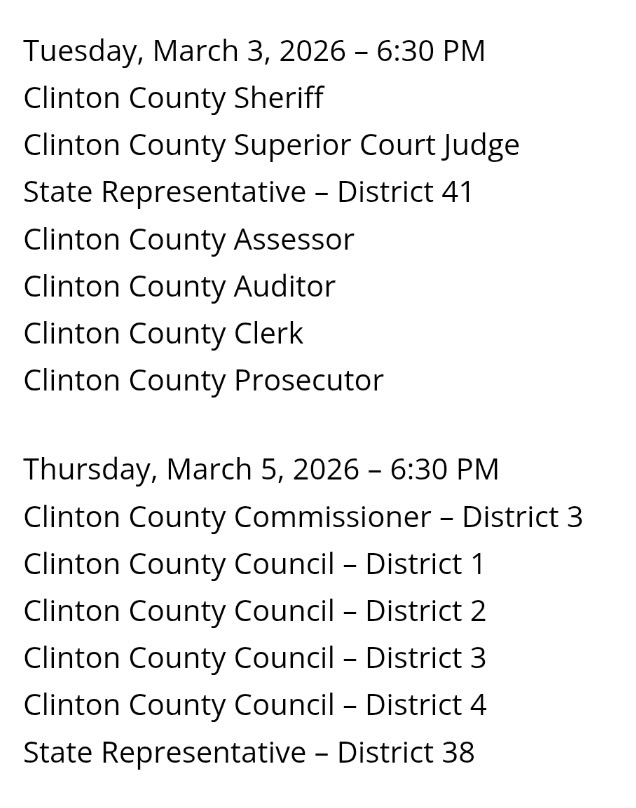
Hoosierland TV will also broadcast LIVE and World-Wide the Clinton County Candidate Forums Scheduled for March 3rd and 5th at 6:30 PM at the Skanta Theatre located inside the Frankfort Public Library located on the corner of Columbia and Clinton in Frankfort.