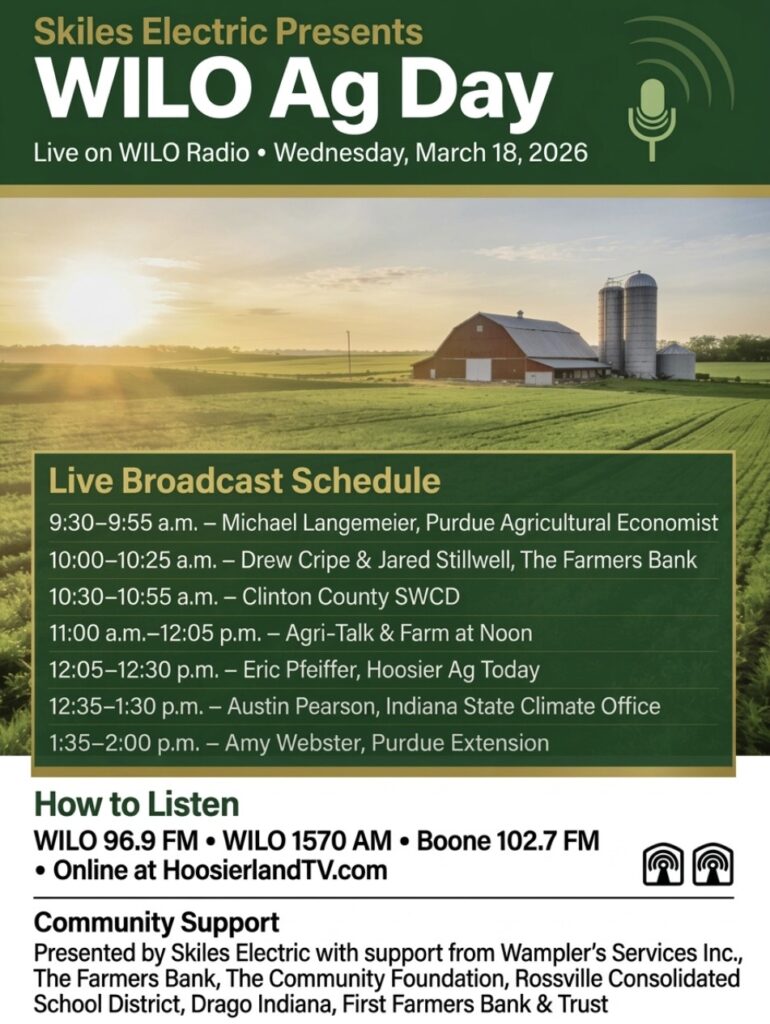
Farmer confidence ticked up slightly in February, but long-term anxiety about the agricultural economy is deepening, Purdue agricultural economist Dr. Michael Langemeier told WILO’s Ag Day 2026 broadcast this week. He said tight margins, rising input costs and policy uncertainty are weighing on crop producers even as livestock producers, especially in beef, see strong returns.
Barometer up, outlook down
Langemeier explained that the Purdue University/CME Group Ag Economy Barometer, a monthly nationwide survey of crop and livestock producers, rose from 113 in January to 116 in February, signaling slightly improved sentiment about current conditions. “The primary Ag Economy Barometer index actually increased a little bit from February to January,” he said, noting that sentiment remains well below late-2025 levels.
What concerns him most is the five-year outlook. “What’s a little bit disconcerting to me is the sentiment related to future expectations is down quite a bit,” Langemeier said, pointing out that the Future Expectations Index now stands about 45 points below its February 2025 reading. He linked that slide to producers “losing a little bit of confidence in the long-run policy environment,” including uncertainty about trade and broader U.S. agricultural policy.
Crops squeezed, beef buoyant
Roughly 70 percent of survey respondents are crop producers, and Langemeier said they are feeling “very tight returns,” especially in corn. “High input costs and low prices” have consistently ranked as farmers’ top concerns since COVID, he said.
By contrast, about one-third of respondents are livestock producers, and most of those are in beef, where conditions are much stronger. “The sector that is doing well at this phase of the beef cycle is the cow-calf,” Langemeier said, adding that elevated calf and feeder prices make backgrounding and finishing cattle “a very risky business” right now. He expects cow-calf operations to see “really good returns” for several years because rebuilding the national herd will take time.
Land values still rising, but less optimism
Despite the caution, most farmers still expect farmland values to increase over the next 12 months and five years, Langemeier said. “They’re still overwhelmingly [thinking] land values are going to go up,” he noted, but “it’s just not quite as high a percentage” as in 2025.
He added that producers continue to worry about land leaving production agriculture for uses such as solar development and urban expansion from cities like Indianapolis. “Those concerns persist across the Corn Belt,” he said.
Corn, soybeans and higher break-even costs
Langemeier highlighted a stark contrast between corn and soybeans. Corn stocks-to-use are running above average, around 13 percent versus a typical 11 percent, putting “a lid on prices” despite strong demand from feed, ethanol and exports. Soybean stocks are only slightly above average, so “any positive new news related to demand” has been boosting soybean prices this year.
He warned that recent fertilizer and fuel cost increases tied to Middle East tensions are likely to push corn break-even prices back above 5 dollars per bushel, erasing modest relief producers briefly saw. “I just don’t see our break-even prices declining any time soon,” Langemeier said, citing stubbornly high fertilizer, fuel and cash rent expenses.
Planning, storage and risk management
With margins tight, Langemeier urged farmers to sharpen both marketing and financial planning. For 2026 corn and soybean marketing, he said on-farm storage “typically pays,” with partial sales at harvest and additional sales in the spring often capturing higher prices. He also encouraged producers to consider hedging strategies and to use Purdue’s Center for Commercial Agriculture tools on budgets, cash rent and repayment capacity.
“In this environment, it’s extremely important to have a contingency plan,” Langemeier said, advising farmers to project cash flow, test their ability to meet term debt, and decide in advance how they would respond if prices fall below expectations. “If I can’t [make payments], what would I need to do in order to make those payments?” he said, emphasizing proactive planning over waiting for problems to emerge.
———————————-
WILO and Hoosierland TV Hosts Melissa Miller and Adam Shanks interviewed leaders in Indiana Agriculture from 9:30 AM to 2 PM March 18, 2026.
Skiles Electric presented Ag Day 2026 with support from Wampler’s Services Inc., The Farmers Bank, The Community Foundation, Rossville Consolidated School, and First Farmers Bank and Trust.
Broadcast on Hoosierland TV was produced by Michael Hall. Broadcast on WILO 96.9, Boone 102.7 FM and WILO 1570 was produced by Dacen Brittain.